New academic year brings new challenges: Education Ministry held a seminar on "Preparations for the 2026/2027 Academic Year"
Published:14.08.2026
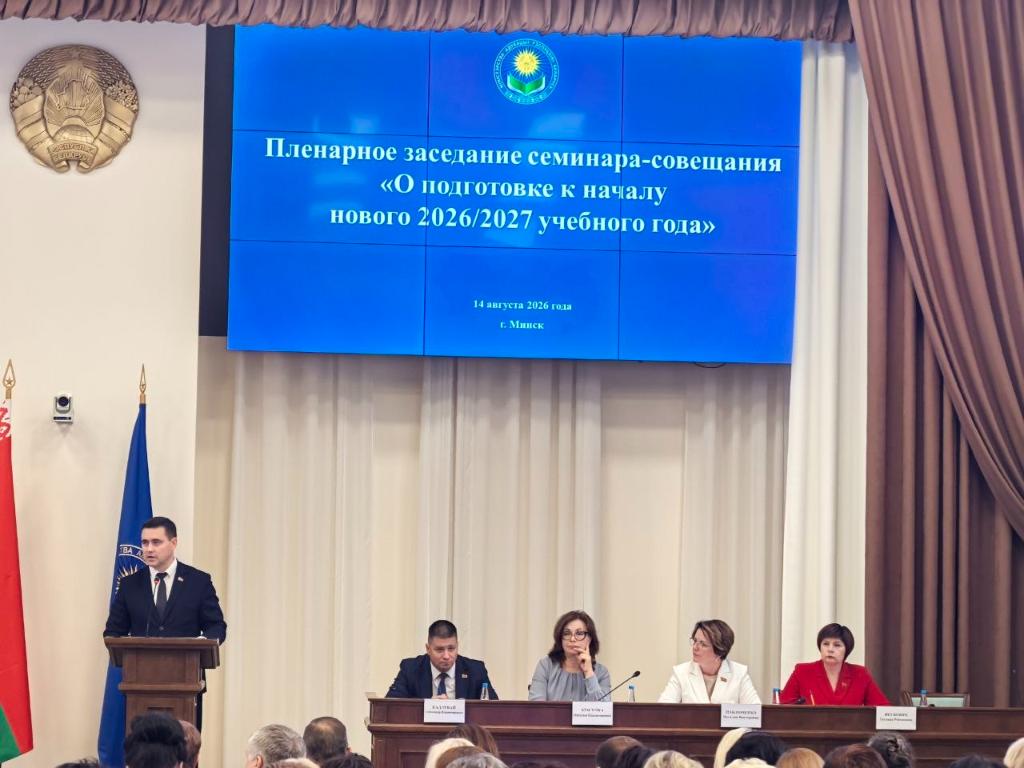 New academic year brings new challenges: Education Ministry held a seminar on "Preparations for the 2026/2027 Academic Year"
Over 150 heads of education departments and divisions from across the country today discussed the priorities of the upcoming academic year, from preschool and general secondary education to vocational training and educational work.
The day before, over 400 heads of educational institutions and specialists from education authorities took part in thematic sections covering all levels of the system, from preschool to vocational education.
"The education system has a wonderful tradition of collectively discussing all innovations and problematic issues requiring special attention and sharing existing experiences before the start of the academic year," noted Education Minister Andrei Ivanets, opening the plenary session.
The plenary session agenda includes:
* priority areas for the development of preschool, general secondary, and vocational education in the 2026/2027 academic year;
* scientific and methodological support for general secondary education;
* the readiness of secondary vocational education institutions for the new academic year in the context of implementing the objectives of the "Intellectual Belarus" State Program for 2026-2030;
* New ways for the development of vocational and secondary specialized education;
* Key areas of ideological and educational work;
* Current areas for preventing student distress.
The Minister of Education to journalists: Key innovations of the new academic year
Andriy Ivanets answered journalists' questions and discussed the key innovations expected in the education system starting September 1, 2026.
Preschool Education: Flexibility and Accessibility
The head of the department emphasized that the priority in preschool education is the creation of flexible work schedules that meet the needs of young families. This year, a new preschool education standard and program were adopted, focused on inclusion, functional literacy, and the development of children's intellectual and creative potential.
"The emphasis is on creating short-term groups of 2 to 4 hours, forming 12-hour groups, and continuing to develop a network of nursery groups for children under 2 years old." "This should be the main focus for every young mother to be able to prove herself professionally and raise her child," the Minister noted.
School: The Teacher is the Main Component
Starting the new academic year, a new school for academic subject teachers will be launched at the Academy of National Education. It will be based on an in-depth analysis of the results of the admissions campaign, the centralized exam, the national survey of education quality, and national assessments.
Furthermore, a pilot project will be launched for eighth-graders offering in-depth study of mathematics, physics, chemistry, and biology.
At the same time, the Minister emphasized his commitment to traditional forms of education:
"We are committed to traditional forms of education. The teacher is the central figure. Learning should take place face-to-face, eye-to-eye. New educational technologies are far from limited to digital services—they are simply an element of supplementation outside of school hours."
Starting September 1, a new version of the unified information and educational resource will be launched, featuring personal accounts for teachers and students. This will enable the development of individualized educational trajectories for each student and provide access to cutting-edge methods and practices.
Special and Inclusive Education
"In inclusive education, we see the importance of providing a flexible educational path for each child. Working with such children requires a truly individualized approach," emphasized Andrey Ivanets.
Plans include expanding the functionality of special education and rehabilitation centers, developing integrated groups and classes in preschool and general secondary education institutions, and ensuring accessibility and socialization for children with special needs. An updated list of equipment for creating a modern inclusive environment has been shared with all regions.
Vocational Education: Competence Centers of a New Format
The Minister announced a major modernization and complete overhaul of existing college-based competence centers:
"Today, this is not just a networked form of training for students from across the country, but must also be advanced development centers—centers for training the specialists of tomorrow."
In each regional center, college-based centers will be established to train specialists in robotics and unmanned production, in accordance with the National Socioeconomic Development Program for the current five-year period. It is planned to leverage the best practices of Russia and China to implement this project.
Professional skills competitions will be elevated to a fundamentally new level: regional stages will be held in the format of festivals in the fall, and the finals of the 7th Republican "Profskills" competition will take place in April.
Continuing Education: New National Center
The National Center for Supplementary Education for Children and Youth will open on September 1st. It will provide methodological support and a balanced range of clubs in creative, sports, arts, and intellectual fields.
Innovations include:
- The first summer school for students from engineering and technical centers;
- The 2nd Republican Olympiad for Schoolchildren and Students in Artificial Intelligence;
- In-person training seminars for engineering and technical teachers at the National Children's Technology Park.
Academy of National Education
The Minister announced that the Academy of National Education will begin operating in full on September 1st. It will unite three scientific and methodological organizations: at the preschool, general secondary, and specialized education levels, at the vocational education level, and at the higher education level.
"Essentially, the Academy will unite scientific, methodological, and academic support at all levels of education in our country," concluded Andrey Ivanets.
Press-center of the Ministry of Education.